
 Order ELM-USB, an universal multi-protocol
OBD-2 ELM32x compatible USB interface
Order ELM-USB, an universal multi-protocol
OBD-2 ELM32x compatible USB interface
OBD-II Protocols
An OBD2 compliant vehicle can use any of the five communication protocols: SAE J1850 PWM, SAE J1850 VPW, ISO9141-2, ISO14230-4 (KWP2000), and since 2003 also ISO 15765-4/SAE J2480. ELM-USB and OBDTester support all of them.Some websites say they support 9 or even more protocols. This is because they mistakenly count protocol variants as separate communication protocols. If you add 4 variants of CAN-BUS to our list, you are on 9.
Please note that some models are equipped with SAE J1962 connector, but these cars are NOT OBD2 compliant. Typical examples of such cars are some early VW/Skoda/Seat models (European versions only), Ford cars with EEC-IV using Ford DCL protocol (e.g. Ford Escort), Nissan EU/Asian models (using Nissan DDL protocol), or some European Hyundai models.
ISO15765-4 (CAN-BUS)
The most modern protocol, mandatory for all 2008+ vehicles sold in the US. Uses pins 6 and 14 (referenced to signal gound), communication is differential.Four variants of ISO15765 exist. They differ only in identifier length and bus speed:
- ISO 15765-4 CAN (11 bit ID,500 Kbaud)
- ISO 15765-4 CAN (29 bit ID,500 Kbaud)
- ISO 15765-4 CAN (11 bit ID,250 Kbaud)
- ISO 15765-4 CAN (29 bit ID,250 Kbaud)
ISO14230-4 (KWP2000)
Very common protocol for 2003+ vehicles using ISO9141 K-Line. Uses pin 7.Two variants of ISO14230-4 exist. They differ only in method of communication initialization. All use 10400 bits per second.
- ISO 14230-4 KWP (5 baud init,10.4 Kbaud)
- ISO 14230-4 KWP (fast init,10.4 Kbaud)
ISO9141-2
Older protocol used mostly on European vehicles between 2000 and 2004. Uses pins 7 and optionally 15.SAE J1850 VPW
Diagnostic bus used mostly on GM vehicles. Uses pin 1, communication speed is 10.4 kB/sec.SAE J1850 PWM
Diagnostic bus/protocol used mostly on Ford. Uses pins 1 and 2, communication signal is differential and it's rate is 41.6kB/sec.Determining protocol from OBD-2 pinout
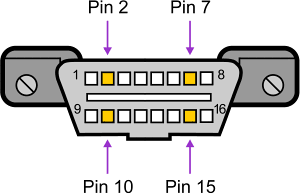 As a general rule, you can determine which protocol your vehicle is using by looking at the pinout of the OBD-II connector:
| Standard | Pin 2 | Pin 6 | Pin 7 | Pin 10 | Pin 14 | Pin 15 |
|---|---|---|---|---|---|---|
| J1850 PWM | must have | - | - | must have | - | - |
| J1850 VPW | must have | - | - | - | - | - |
| ISO9141/14230 | - | - | must have | - | - | optional |
| ISO15765 (CAN) | - | must have | - | - | must have | - |